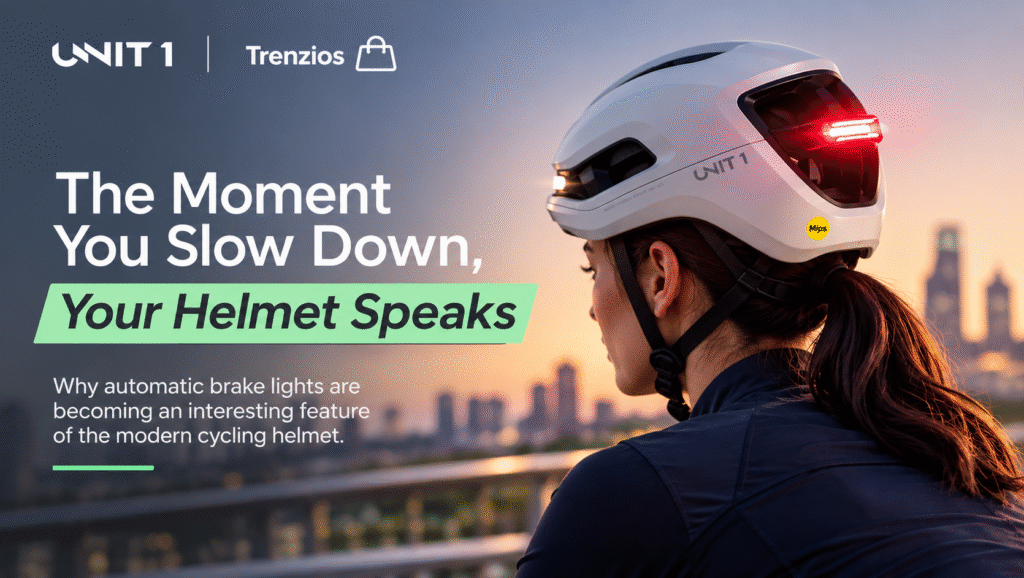
Why automatic brake lights are becoming an interesting feature of the modern cycling helmet
A cyclist approaches a junction, eases off the pedals and begins to slow. The rider behind can see the change in speed through body movement and the bicycle itself. A driver further back may have a much less obvious view. That small moment—when forward motion turns into braking—is where a clear visual cue can matter.
UNIT 1 builds that idea into selected smart helmets. Rather than relying only on a rider remembering to switch on a light, the brand’s AURA, NEON and FARO helmet families include an automatic brake-light function: the rear light responds when the rider slows down. It is a compact feature, but it speaks to a larger shift in cycling equipment—from passive accessories towards connected, active visibility.
A brake light on a bicycle: what is it actually doing?
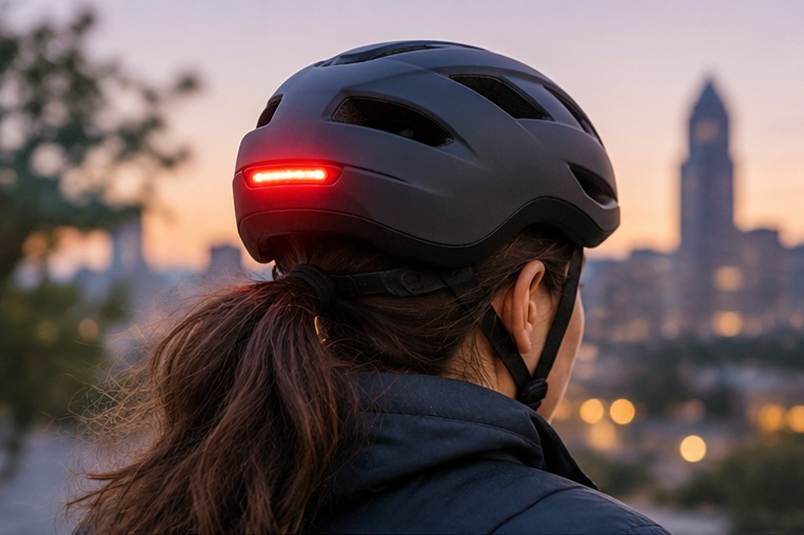
On a car, brake lights are a familiar signal. On a bicycle, the rider has traditionally relied on positioning, slowing gradually and using hand signals where appropriate. A helmet with an automatic brake-light feature adds another cue at the back of the rider.
UNIT 1 describes automatic brake lights as part of its smart-helmet feature set. On supported models, the rear light illuminates or changes its behaviour as the rider decelerates. The intention is straightforward: make a change in speed easier for people behind to notice, especially in stop-start urban traffic.
It is not a substitute for awareness, predictable riding or legally required bicycle lights. Think of it as an additional communication layer—not a guarantee that every driver or cyclist will see and interpret the signal correctly.
Where the feature fits in UNIT 1’s helmet range
The brand’s smart-helmet range is not one-size-fits-all. The models differ in lighting configuration, intended use and additional features. If automatic braking visibility is the feature that brought you here, compare the exact model and variant before ordering.
| Model | Lighting setup | Other relevant features | Best fit |
| AURA | Front and rear lights | Automatic brake light; turn signals with separately sold UNIT 1 Remote; Crash Alert via app; MIPS on Mips version | Riders wanting a full front-and-rear lighting setup for city and road use |
| NEON | Rear light; no front light included | Automatic brake light; turn signals with separately sold Remote; Crash Alert via app; Safety ID | Everyday city riders who want a streamlined helmet with rear visibility |
| FARO | Front, rear and hidden lights | Automatic brake light; turn signals with separately sold Remote; Crash Alert via app; MIPS on Mips version | City riders who want a more visibility-focused lighting arrangement |
Why automatic lighting matters most in ordinary traffic
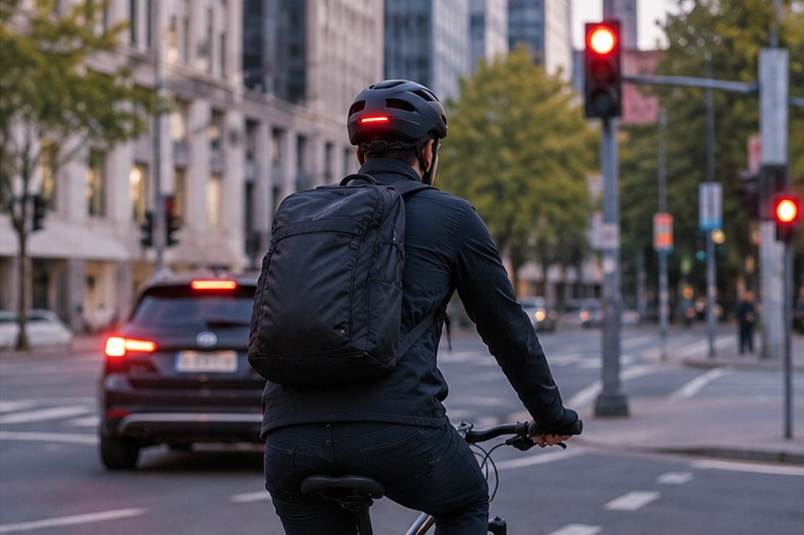
The feature is easy to imagine in everyday situations. A commuter slows before a pedestrian crossing. Someone on an e-bike eases off approaching a queue of cars. A rider brakes gently at a junction or on a shared path. In each case, the rider is changing speed while other road users are making decisions around them.
A rear light that reacts to deceleration can make that change more noticeable. It is particularly relevant in the stop-start rhythm of city riding, where the distance between moving and stationary traffic can change quickly. It may also be useful on familiar routes where a rider repeatedly approaches crossings, traffic lights and busy entrances.
The important word is ‘additional’. A brake light cannot make a poor riding position safe, remove blind spots or force another road user to respond. Riders should continue to signal clearly, ride defensively and use the lighting required by local law.
The wider smart-helmet system
Automatic brake lighting is only one part of the UNIT 1 proposition. AURA, NEON and FARO also support turn signals through the UNIT 1 Remote, which is sold separately. The rider can use the remote to indicate a turn without relying solely on a hand gesture, although the brand’s terms make clear that electronic signals do not replace legally required hand signals.
Crash Alert is another connected feature available through the UNIT 1 app on supported models. The company describes it as a system that can notify emergency contacts after a detected crash if the rider does not respond. As with any connected safety feature, users should read the setup instructions, check app permissions and understand the conditions under which alerts are triggered.
AURA and NEON are listed with e-bike certification up to 45 km/h and standards including NTA-8776, EN-1078 and CPSC. FARO is listed with EN-1078 and CPSC certification, up to 25 km/h. Always confirm the certification printed for the exact helmet variant and the rules that apply where you ride.
Before choosing a UNIT 1 helmet
- Check the fit first. Measure your head and use the brand’s sizing guidance; smart features cannot compensate for a helmet that does not fit correctly.
- Compare the light layout. AURA and FARO include front and rear lighting; NEON has a rear light and does not include a front light.
- Check accessory requirements. Turn signals require the separately sold UNIT 1 Remote.
- Review the exact certification. E-bike speed categories and standards differ between models.
- Understand the limitations. Helmet lights and signals are supplementary and may not replace legally required bicycle lights or hand signals.
- Check battery and care instructions. Follow the manufacturer’s charging, cleaning and maintenance guidance.
A small signal, built into the ride
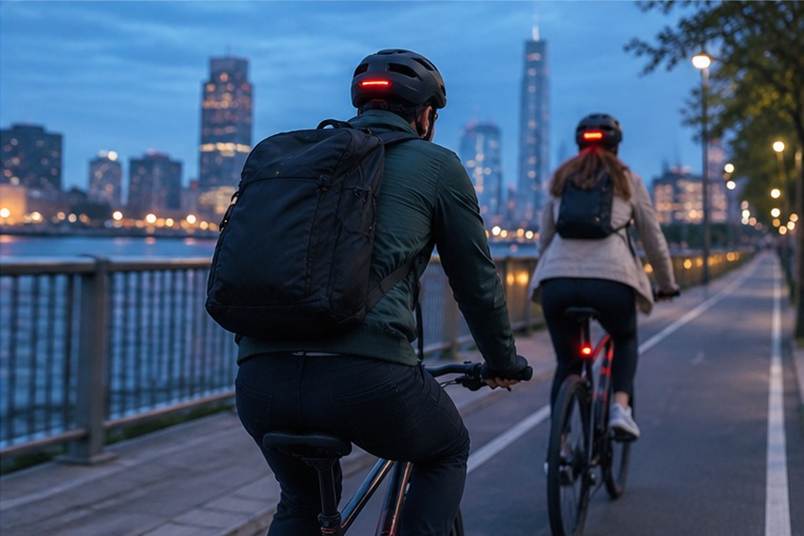
The appeal of an automatic brake light is its timing. It responds at the moment the rider slows, rather than asking the rider to remember one more control in the middle of traffic. For commuters and e-bike riders who spend time around junctions, queues and mixed road users, that extra visual cue is a thoughtful addition to the helmet.
UNIT 1’s AURA, NEON and FARO bring that idea into a wider smart-helmet system, with different lighting layouts and connected features across the range. The right choice depends on your route, the visibility setup you want, your fit and the specific model’s certifications—not simply the longest feature list.
Explore the UNIT 1 range and compare the current model specifications before choosing the helmet that suits your everyday ride.
Affiliate disclosure: This article contains an affiliate link. If you make a purchase through it, the publisher may earn a commission at no additional cost to you.