Here’s an uncomfortable exercise: open your bank statement and add up every subscription charge from last month. Streaming, music, AI tools, creative software — the full list. For most households, the total lands somewhere between “more than I thought” and “genuinely annoyed now.” And here’s the truly frustrating part: for almost every one of those services, a dramatically cheaper way to pay already exists. Not a coupon, not a trial, not a downgrade to the ads tier — the same premium plan, at a fraction of the price.
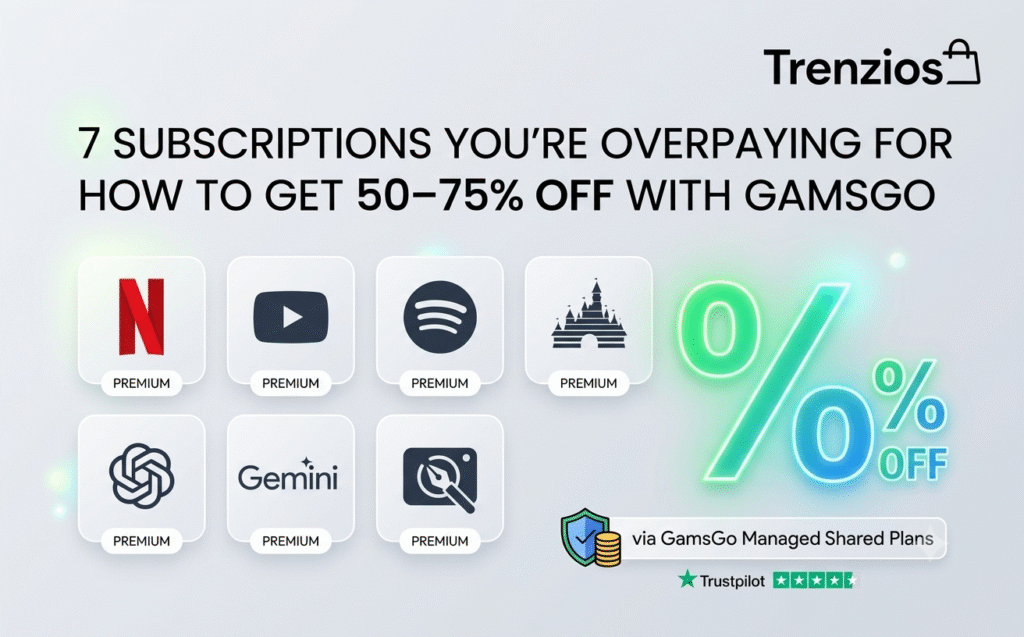
The mechanism is group pricing. Nearly every major subscription service sells family or group plans that cost far less per seat than individual plans — the services themselves designed it that way. The catch has always been coordination: you need people to share with, someone to collect the money, and someone to manage the account. GamsGo, founded in 2020 and headquartered in London, sells exactly that coordination. You pick a service and pay GamsGo; the platform slots you into a shared group, splits the cost, and manages everything — backed by a warranty on every order, 24/7 support, and a Trustpilot profile of more than 14,000 reviews. The savings run 50–75% off official pricing across the board. Here are the seven subscriptions where it pays off most.
1. Netflix Premium — the Poster Child of Price Creep
Netflix’s Premium tier has climbed relentlessly, and the platform famously offers no annual plan to soften the blow — every increase hits your monthly bill immediately and forever. Yet Premium is built for sharing: it’s the tier with 4K and multiple simultaneous streams. Through a shared plan, you get the full Premium experience — the 4K, the downloads, your own profile — while splitting the cost that Netflix designed to be split. For most people this single swap is the largest line-item saving on the entire statement, and it’s the perfect first migration.
2. YouTube Premium — the One Everyone Almost Buys
YouTube Premium sits in a strange psychological spot: everyone hates the ads, everyone almost subscribes, and a huge share of people balk at paying streaming-service money to remove them. Shared pricing dissolves the objection. At a few dollars a month for ad-free viewing, background play and YouTube Music bundled in, the value calculation flips completely — it stops being “is ad-free worth this much?” and becomes “why did I watch ads for three years?”
3. Spotify Premium — Small Fee, Endless Duration
Music subscriptions are the marathon of the stack: you’ll likely pay for one every month for the rest of your listening life. That endless duration is exactly why the percentage matters more than the sticker. Cutting a music subscription by two-thirds looks modest in any single month — but compound it across years of listening and it quietly becomes one of the biggest lifetime savings on this list. Same playlists, same offline downloads, same everything, permanently cheaper.
4. Disney+ — the Family Plan for Actual Families
Disney+ earns its slot in most households the moment kids are involved, and the premium tier’s simultaneous streams mean bedtime cartoons in one room don’t interrupt a Marvel marathon in another. It’s also precisely the kind of service people forget they’re paying full price for — set up once during a holiday, never revisited. A shared plan keeps every profile and every stream while cutting the fee by more than half, which makes it the easiest “found money” swap on the list.
5. ChatGPT Plus — the New Essential
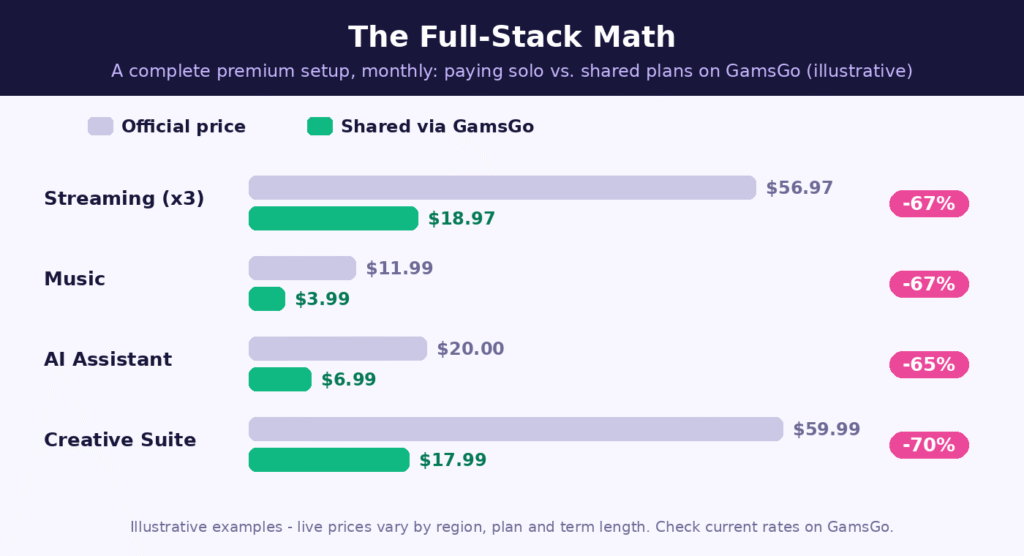
Somewhere in the last two years, an AI assistant went from curiosity to infrastructure. ChatGPT Plus is the subscription professionals and students describe as the last one they’d cancel — which is exactly why paying full retail for it stings. Shared access delivers the same premium models and features at roughly a third of the official rate, and GamsGo’s AI category is where the platform’s discounts run deepest overall, with yearly plans advertised at up to 90% off. If you use AI daily, this is the highest-leverage swap on the entire list.
6. Gemini Pro — the Stack Expander
Here’s what shared pricing actually changes: at official rates, almost nobody runs two AI subscriptions — the second twenty-dollar bill is where everyone draws the line. At shared rates, the second tool costs less than a takeaway coffee, and suddenly the power-user setup — drafting in one model, cross-checking in another, generating images in a third — is available to anyone. Gemini Pro’s image and video generation plus Google Workspace integration make it the natural second pillar, and shared pricing is what makes the second pillar thinkable at all.
7. Adobe Creative Suite — the Big-Ticket Redemption
Adobe is the subscription people resent most: indispensable for creative work, priced like it knows it. It’s also where shared access produces the single most dramatic number on this list — the gap between the official rate and the shared rate on a creative suite is bigger than the entire cost of most other subscriptions combined. For freelancers, students and side-hustlers who’ve been limping along on free alternatives out of principle, this is the swap that pays for every other subscription on the page.
Same subscriptions. Half the bill.
▶ UNLOCK YOUR SAVINGS ON GAMSGO
Honorable Mentions: The Rest of the Catalog
Seven headliners, but the catalog runs deeper. Crunchyroll for anime households — where the premium tiers’ simultaneous streams make sharing a natural fit. Research-focused AI tools for students and analysts. Additional streaming and music services depending on your region. The pattern is always the same: wherever a service sells group access, GamsGo turns that group price into your individual price. If it’s on your bank statement, it’s worth thirty seconds to check whether it’s in the catalog — the answer is yes more often than most people expect.
How the Switch Actually Works
The process is deliberately boring, which after years of sketchy “discount” workarounds is exactly what you want. Browse the catalog and pick your service. Choose a term — 1, 3, 6 or 12 months, with longer terms carrying deeper per-month rates and no forced annual lock-in anywhere. Check out through secure payment. GamsGo slots you into a shared group automatically and activates access — quoted within 24 hours, usually delivered in minutes. From then on, everything lives in one dashboard: renewal dates, remaining time, every service in one view, with advance notice before any renewal so nothing ever ambushes your card.
And every order ships with the safety net that makes the whole model trustworthy: a free warranty period during which any account issue gets a fix or a refund, a published refund process you can track from your order history, and 24/7 support that users consistently report answers within about ten minutes. That combination — warranty, refunds, instant support — is what separates a managed platform running since 2020 from the anonymous credential sellers that give subscription savings a bad name.
The Order of Operations
Start with your most expensive service. Biggest bill, biggest instant saving, fastest proof the model works — for most people that’s premium streaming or a creative suite.
Migrate the daily drivers next. Music and AI are the services you touch every day; moving them locks in savings you’ll feel every month indefinitely.
Then expand, don’t just save. Once the core stack costs half, the freed-up budget covers services you always wanted but never justified — the second AI tool, the anime library, the premium tier. Half the households that come to save end up upgrading instead, at the same total spend as before.
And test before you commit. Every migration can start with a single one-month term. If the shared experience matches the solo one — and for the overwhelming majority of users it does, seamlessly — step up to the longer term and bank the deeper rate. The worst-case cost of trying is a few dollars for a month of a service you were going to pay triple for anyway; the best case rewrites your subscription budget for good.
Final Thoughts
Nobody hands out awards for overpaying, and subscription services will never call to mention that a cheaper way to buy their own product exists. The seven services above are where the gap between the solo price and the shared price is widest — and closing that gap takes one platform, one dashboard, and a few minutes per service. Same Netflix, same Spotify, same ChatGPT, same Adobe. Half the bill, a warranty behind every order, and support that answers before your tea cools. The only thing you’re giving up is the overpaying.