
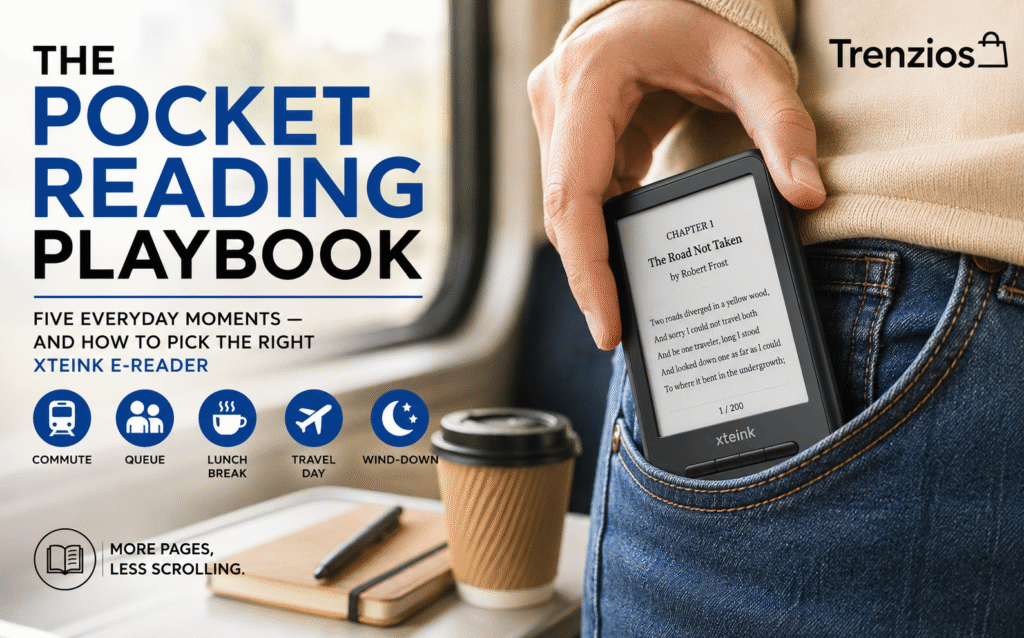
Your phone already won the fight for your pocket. Here’s how a 58-gram e-reader wins it back — and how to choose between the X3 and the X4 Pro properly.
The average reader does not have a reading problem; they have a proximity problem. The book is on the nightstand, the phone is in the pocket, and the pocket wins every queue, every commute, every idle minute. The fix that actually works is not another app or a screen-time limit — it is putting a real reading device in the same pocket the phone lives in. That is the entire premise Xteink has built its company on.
This is where the device decision quietly makes or breaks the habit. The wrong e-reader — too big to carry everywhere, locked to a store you don’t buy from, dead when you finally reach for it — turns a good intention into a drawer ornament. The right one disappears into the background of your day, which is exactly what it should do.
Xteink has become the unlikely poster child for this idea: its wallet-sized e-readers went viral among book lovers precisely because they encourage reading over scrolling, and the current line-up is refreshingly small. The X3 is a $69, 58-gram slab with a 3.7-inch e-ink screen and physical page-turn buttons; the new X4 Pro is a $99, 72-gram upgrade with a 4.3-inch touchscreen and a warm front light, at 5.95 mm thinner than most phones. Both fit in the fifth pocket of your jeans. Here is the playbook.
The Five Moments Worth Building a Habit Around
1. The Commute — The 40 Minutes You Already Own
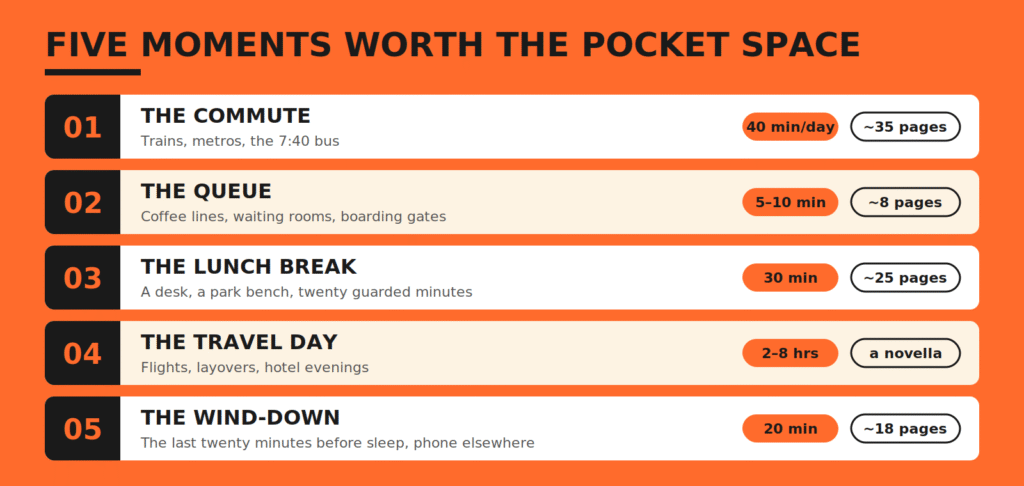
Trains, metros and buses are where doomscrolling does its best work, which makes them the highest-value real estate for a pocket e-reader. Forty minutes a day is roughly thirty-five pages — a book every ten working days without changing anything else about your life. Reader call: either model works, but the X4 Pro’s touchscreen makes one-handed, strap-hanging navigation noticeably easier, and its front light covers dim winter platforms.
2. The Queue — Reading in the Gaps
Coffee lines, waiting rooms, boarding gates: five to ten minutes at a time, several times a day. This is the moment the X3 was born for — light enough that you forget it until the queue forms, cheap enough that tossing it in every jacket is rational. The magnetic case (free with the X3) means it survives sharing a pocket with keys.
3. The Lunch Break — The Guarded Half Hour
A chapter over a sandwich is the most reliably defended reading slot in a working day, because nobody schedules meetings over lunch twice. E-ink earns its keep here: after a morning of monitors, a paper-like screen is a rest for the eyes rather than another dose of backlight.
4. The Travel Day — Where E-Ink Embarrasses the Tablet
Flights are the e-reader’s home fixture: no glare in a window seat, no anxiety about the battery, no airline Wi-Fi temptations. The X4 Pro’s 1100 mAh cell reportedly sat at 60% after three weeks of regular use in early reviews — weeks of battery measured honestly, not in marketing hours. Load a microSD card (both models take up to 256 GB) and you are carrying a library that weighs less than your boarding-pass wallet.
5. The Wind-Down — The Last Twenty Minutes
Reading before sleep works only if the phone stays outside the bedroom, and that only happens if something else does the job. This is the strongest case for the X4 Pro over the X3: its adjustable front light has a warm colour-temperature mode for night reading, while the X3 has no light at all and needs a bedside lamp.
https://go.sjv.io/c/7343301/3930529/54011?partnerpropertyid=8445463&MediaPartnerPropertyId=8445463▶ START READING SMALLER — SHOP THE LINEUP AT XTEINK.COM
Step 1: Match the Reader to the Moment, Not the Spec Sheet
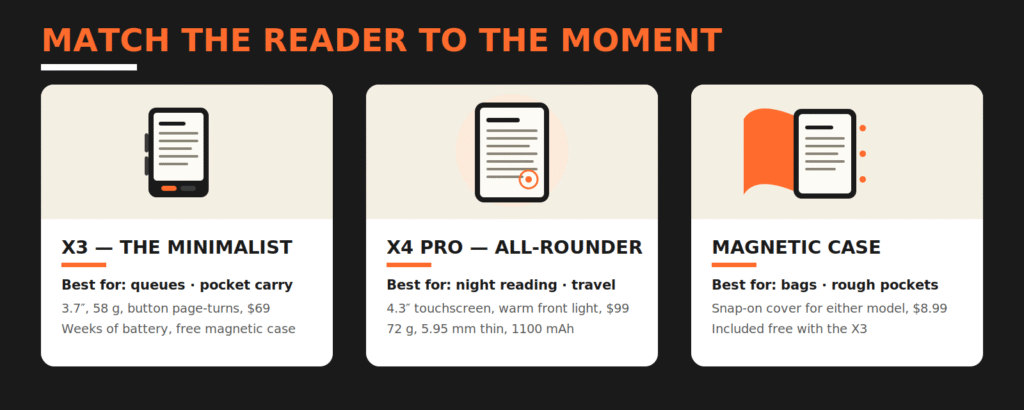
The most common mistake is buying for the feature list rather than the moment you’ll actually use it in. Work backwards from your day: if your reading happens in queues and pockets, the X3’s simplicity — buttons, no light, $69 — is the feature, and its 650 mAh battery lasts weeks precisely because there is nothing to drain it. If your reading happens on trains, planes and in bed, the X4 Pro’s touchscreen and warm front light are worth the extra $30. If you genuinely cannot decide, the X4 Pro is the safer default: it does everything the X3 does, plus the two things owners most requested.
Step 2: Buy Direct, and Mind the Launch Window
Xteink sells direct at xteink.com, and right now the direct channel is where the deals live: the X4 Pro is $99 against a $109 list price, with shipping from August 22, and the X3 is $69 (down from $79) with the magnetic case thrown in free. The X4 Pro launched as an exclusive on Xteink’s own site, so aggregator listings and marketplaces lag both on price and on stock. Buying direct also means firmware updates and support come from the people who actually built the thing.
Step 3: Understand the Format Rules Before You Load Your Library
This is the honest paragraph most product pages skip. Xteink readers speak EPUB and TXT (plus JPG and BMP images) and transfer files over Wi-Fi or microSD. What they do not do is DRM: no Kindle-store purchases, no Libby library loans. If your library lives inside Amazon’s walled garden, this is not your device. If your library is DRM-free EPUBs — public-domain classics, Standard Ebooks, indie storefronts, technical publishers — the open format is a feature, not a gap: your books are files you own, on a device with zero third-party restrictions.
Step 4: Learn the Three Habits of Pocket Reading
First, placement: the reader must live where the phone lives — same pocket, same bag compartment — or the phone wins by default. Second, charging: both models use a magnetic pogo-pin cable rather than USB-C, so leave the cable in one fixed place (bedside or desk) and top up fortnightly; lose it mid-trip and you can’t borrow a charger, though the weeks-long battery makes this a smaller risk than it sounds. Third, loading: refill the device the way you refill a bookshelf — a batch at a time over Wi-Fi transfer, so there is always a next book waiting when one ends.
Step 5: Explore the Firmware Even If You Think You Won’t
Xteink ships its devices deliberately unlocked, and the community has repaid the favour: CrossPoint, an open-source firmware built by enthusiasts, adds browser-based book loading, OPDS catalogue support and KOReader sync — and Xteink, rather than fighting it, now collaborates with its developers. You don’t need any of this on day one. But an e-reader you can reflash from a browser is an e-reader that gets better after you’ve bought it, which is not something the big-brand alternatives can say.
Three Mistakes This Playbook Prevents
First: buying the bigger reader ‘to be safe’ and leaving it at home. The device you carry beats the device you admire — match the model to your smallest pocket, not your largest ambition. Second: discovering the DRM rules after loading day. Know where your books will come from before you order, and if the answer is ‘the Kindle store’, stop here. Third: treating it as a gadget instead of a habit. The hardware is solved at 58 grams; the habit is placement, charging and a loaded library, and this playbook just handed you all three.
Final Thoughts
The pocket e-reader is the rare purchase that gets more valuable the more boring your day is — every queue, commute and layover quietly converts into pages. Pick the moment you actually read in. Match the model honestly: X3 for the pocket, X4 Pro for the night. Buy direct while the launch pricing holds, load it with books you own, and put it exactly where your phone used to be. Xteink built the machinery small enough to disappear; the reading is the part you bring.
▶ EXPLORE THE POCKET LINEUP — SHOP XTEINK
Disclosure: This article contains affiliate links. If you make a purchase through them, Trenzios may earn a commission at no extra cost to you.ˀ