
Most people in Hungary know Alza as “the electronics place.” That’s how it enters your life, usually. You need a laptop charger or a new phone, someone tells you to check Alza, you check Alza, you buy the thing, it turns up. Job done.
And then, at some point, you notice the drop-down menu.
Because the catalogue on Alza.hu is not an electronics catalogue with a few extras bolted on. It’s a genuinely broad retail operation that happens to have grown out of tech. Once you actually read the category list rather than searching for the one thing you came for, the whole shape of the site changes. So let’s go through it properly, the way you’d walk through a shop with someone who knows where things are.
Start With the Obvious: Phones, Computers, and Everything Around Them
The tech side is where Alza’s depth is most obvious, and it’s worth understanding how deep before you assume you know what’s there.
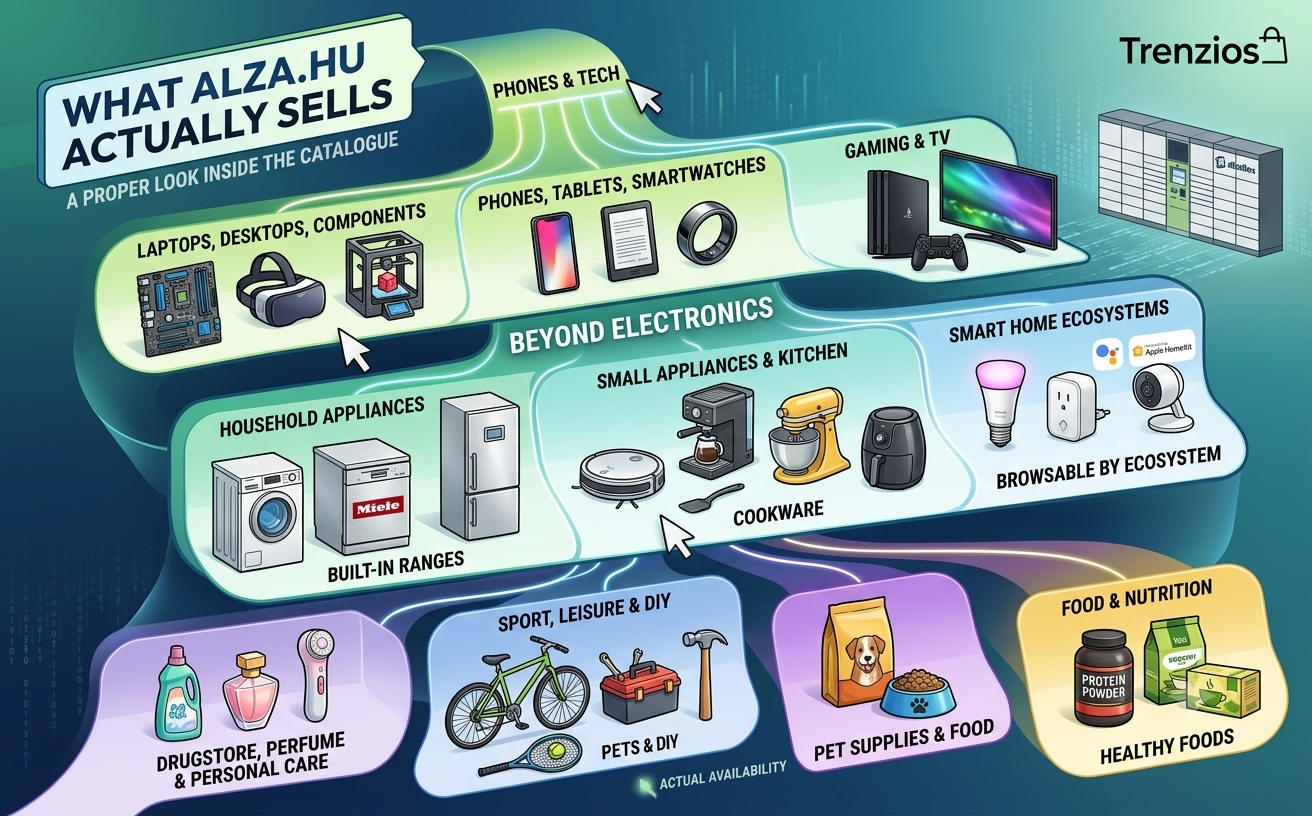
Phones, tablets, and smartwatches sit together as one cluster, and it’s not just handsets. Smart rings are in there now — the Oura line and its competitors — alongside e-book readers, tablet accessories, smartwatch straps, and the sort of phone accessories you only think about in season, like the summer waterproof cases and car mounts that appear when everyone starts driving to Balaton.
The PC and laptop section is the one that tells you what kind of retailer this really is. It isn’t a rack of finished laptops. It’s laptops and pre-built desktops and individual PC components — motherboards, graphics cards, cooling, storage — plus monitors, networking gear, printers and scanners, software licences, projectors, VR headsets, and 3D printing. That’s a specialist computer shop’s entire inventory sitting inside a general retailer. If you build your own machine, you already know how rare that combination is. If you don’t build your own machine, it matters anyway, because it means the people stocking the finished laptops are the same people who understand what’s inside them.
Gaming and entertainment runs parallel — consoles, games, controllers, headsets, chairs, the whole apparatus. And TV, photo, audio and video covers televisions, sound systems, headphones, cameras and lenses. There’s a reason those four categories sit next to each other in the menu. They’re the same customer, at different moments.
The Bit That Surprises People: The Whole House
Here’s where the mental model breaks.
Large household appliances on Alza is a full white-goods department. Washing machines, dryers, fridges, freezers, dishwashers, hobs, ovens, cookers, extractor hoods, built-in appliance ranges, wine coolers, air conditioning, water heaters. There are appliance bundles for people fitting out a kitchen from scratch, a retro appliances section for the ones who care how the kitchen looks, and Miele has its own space, which tells you something about the tier they’re stocking at the top end.
Small appliances is arguably the busier department. Coffee machines, vacuum cleaners and steam cleaners, air coolers and fans, kettles and drinks makers, stand mixers and blenders, irons, heaters, air purifiers, sewing and embroidery machines. Then the personal side: hair and beard care, electric toothbrushes, beauty devices.
Kitchen and household covers the non-electric half — cookware, storage, the unglamorous things you replace once a decade and never think about until you need one.
And smart home has quietly become one of the most complete sections on the site. Smart heating, smart lighting, smart security, smart power management, smart garden, smart appliances, home robots. It’s organised by ecosystem as well as by product, so you can browse by Philips Hue, Apple HomeKit, Google Assistant, Amazon Alexa, Tuya, or Matter. If you’ve ever bought a smart plug that turned out not to talk to anything else you own, you’ll understand why that filtering matters more than the product photos do.
Then It Keeps Going
This is the part where the catalogue stops behaving like an electronics shop entirely.
There’s a drugstore section. Cleaning products, household chemicals, paper goods, personal care. There’s perfume and jewellery. There’s toys and a baby-and-mother department. There’s pet supplies and pet food, as a proper category with proper depth, not a token shelf.
There’s home, DIY and garden. Sport and leisure. Car and motorcycle. Office supplies. Health. And food — which is more interesting than it sounds, because it isn’t a grocery run. It’s healthy foods, sports nutrition, alternative diets, dried meats, teas, syrups, baby food, supplements, gift hampers, and advent calendars when the season comes round. It’s the shelf-stable, high-margin, easy-to-post end of food retail, which is exactly the end that works well online.
There’s a summer equipment section that rotates with the weather. And there’s an energy-saving section, which is its own idea rather than a category — appliances, devices and home solutions grouped by what they do to your bills rather than by what they are.
Why the Breadth Actually Helps You
Now, breadth on its own is not automatically good. Plenty of sites sell everything badly. The reason it works here comes down to two things.
The first is that the range is genuinely stocked rather than theoretically listed. Alza runs its own warehousing, its own store network, and its own AlzaBox parcel lockers, and the site tells you what’s physically available before you commit. That’s the difference between a catalogue and a shop. You’re not ordering into a void and hoping.
The second is that breadth changes the economics of shopping. If you need a toothbrush head, a phone cable and a coffee machine, that’s three orders from three places, three delivery fees, three tracking numbers and three separate afternoons of waiting in. On Alza it’s one basket. That sounds like a small convenience. It isn’t. It’s the reason people who start with an electronics purchase end up buying their dishwasher tablets from the same site two years later — not because of any clever marketing, but because the friction of going elsewhere stopped making sense.
What People Actually Buy
If you want a shortcut through a catalogue this size, look at what’s already moving.
The bestseller lists are visible inside almost every category, and they’re more useful than they look. Not because popularity equals quality — sometimes it just equals a good price that week — but because in a range this wide, the top sellers tell you where Alza’s pricing is currently sharpest. Something that’s outselling everything around it usually isn’t doing that on charm.
Predictably, the movers cluster in the same places. Phones and phone accessories, because everyone breaks a cable eventually. Laptops, especially around the back-to-school and end-of-year windows. Televisions, which shift hard whenever there’s financing attached. Coffee machines, robot vacuums and air fryers, which have quietly become the small-appliance categories that never go quiet. Console games and headsets. Electric toothbrush heads and drugstore restocks, which people add to baskets almost absent-mindedly because they’re already there.
And then the own-brand stuff — AlzaPower cables, chargers and power banks, Alza printer cartridges, the custom-built Alza PCs. Those sell steadily rather than spectacularly, which is usually the better signal. Nobody buys a printer cartridge twice unless the first one worked.
The point isn’t to buy what everyone else bought. It’s that in an unfamiliar category, the bestseller shelf is the fastest way to find the price band where the value actually sits before you start comparing specs.
How to Actually Navigate It
A few things worth knowing before you dive in, because a catalogue this size rewards knowing where to stand.
Use the category tree rather than the search bar for anything you’re not certain about. Search is fine when you know the exact model. But when you’re deciding — when you know you want a washing machine and not this washing machine — the category tree with its filters is where the site earns its keep. You can narrow by availability, by store, by feature, by ecosystem.
Check the availability filter early rather than late. Being able to sort for what’s in stock right now, and for what’s sitting in a store near you, saves the specific frustration of falling in love with something that’s three weeks out.
And look at the promotional sections before you look at the product you came for. The Mega Price Parade and the Alza Days events move across categories, and there’s a dedicated section of AlzaPlus+ member deals. If the thing you want happens to be in a live promotion, you want to know that on the way in, not after you’ve paid.
The Honest Summary
The reason to shop Alza.hu isn’t that it has a lot of products. Lots of sites have a lot of products.
It’s that the depth is real in the categories where depth is hard. Anyone can list a thousand phone cases. Stocking individual PC components alongside built-in ovens alongside sports nutrition alongside pet food, with actual availability behind each one and a delivery network that puts it in a locker near your flat the next morning — that’s the difficult version. That’s infrastructure, and it took a long time to build.
So the practical advice is this. Next time you’re on the site for the one thing you came for, spend a minute in the catalogue menu. Not because you’ll buy something else that day. But because knowing what’s actually in there changes where you look first the next time you need anything at all — and once that switch flips, you stop shopping around and start just shopping.
Go and open the category list. It’s longer than you think.