
AI CAN GIVE YOU PRACTICE. A HUMAN CAN MAKE IT MATTER.
Why live conversation is becoming the most valuable part of learning a language — and how to build a smarter routine with italki.
YOU CAN KNOW THE WORDS AND STILL FREEZE.
You know the vocabulary. You recognise the grammar. You can understand a video if you replay it. You might even score well on an app.
Then someone asks you a simple question in real time.
Suddenly, your brain is searching for a verb, your pronunciation feels unfamiliar in your own mouth, and the sentence you knew five minutes ago disappears.
That gap — between knowing a language and using it — is exactly why live speaking practice remains relevant in 2026. AI tools have made low-pressure practice easier and more available, but recent discussion around language learning increasingly points toward a hybrid routine: use technology for repetition and use human conversation for nuance, correction and real interaction.
The goal is not more studying. It is more moments where the language has to come out of your mouth.
THE NEW LANGUAGE STACK
Think of language learning in three layers rather than one giant routine.
| LAYER | WHAT IT DOES | WHAT YOU NEED |
| INPUT | You hear and read the language. | Videos, podcasts, articles, music and graded content. |
| REPETITION | You practise vocabulary, grammar and pronunciation repeatedly. | Flashcards, exercises and AI-assisted practice. |
| REAL-TIME OUTPUT | You have to understand, respond, improvise and recover from mistakes. | A live conversation with another person. |
STOP BOOKING “LANGUAGE LESSONS.” BOOK A SPECIFIC JOB.
One reason tutoring can become vague is that “learn Spanish” or “improve English” is too broad. A better lesson has a job to do.
THE TRAVEL JOB Practise ordering food, checking into a hotel, asking for directions and handling a misunderstanding.
THE WORK JOB Rehearse a presentation, interview, meeting, negotiation or small talk with colleagues.
THE EXAM JOB Focus the session on the speaking tasks and feedback relevant to your target exam.
THE CONFIDENCE JOB Talk for most of the lesson, with the tutor correcting recurring mistakes without turning the session into a grammar lecture.
THE CULTURE JOB Discuss films, food, current life, humour or everyday expressions that textbooks rarely capture naturally.
This is where a tutor marketplace can be useful: instead of committing to one generic course, you can look for a teacher whose profile, language variety, teaching style and availability fit the job you need done.
THE 20-MINUTE RULE
You do not need every lesson to become a two-hour study marathon. A shorter, focused session can have a very specific objective.
Try this format for a 30-minute lesson:
• 5 minutes — warm-up conversation with no script.
• 15 minutes — one real-world task or topic.
• 5 minutes — tutor feedback on your most important recurring errors.
• 5 minutes — write down three phrases you want to reuse before the next lesson.
The point is not that 30 minutes is universally optimal. It is that every session should produce something you can carry into the next conversation.
AND THIS IS WHERE AI FITS IN.
The rise of AI language tools changes the economics of practice. You can ask an AI system to generate vocabulary drills, simulate situations, explain grammar or give you additional repetition without waiting for a lesson.
That does not make a live tutor irrelevant. It changes what you should ask the tutor to do.
Use automated tools for volume. Use your tutor for judgement.
For example, you can practise 20 restaurant-related phrases with an AI tool before your lesson. Then use the live session to actually order, respond to unexpected questions, recover from misunderstandings and get feedback on what sounds natural.
This hybrid approach is increasingly discussed in 2026 language-learning coverage, including comparisons of AI practice and italki-style human tutoring.

CHOOSING YOUR italki TEACHER: LOOK PAST THE STAR RATING
A tutor marketplace gives you choice, which also means you have to make the choice carefully. Recent learner discussions highlight the importance of checking teacher profiles, videos, lesson focus and fit rather than assuming a high rating automatically means the right match.
| CHECK | WHY IT MATTERS |
| YOUR GOAL | Does the teacher explicitly teach what you need — conversation, business language, exam preparation, beginners, pronunciation or another goal? |
| THE LESSON STYLE | Do you want a structured lesson, guided conversation, corrections throughout, or a mixture? |
| THE LANGUAGE VARIETY | If accent or regional usage matters to you, check what the teacher actually offers rather than relying only on the word “native.” |
| THE SAMPLE | Use the available introduction/trial information to see whether the teaching style feels comfortable and useful. |
| THE SCHEDULE | The best teacher on paper is not useful if the lesson time repeatedly clashes with your life. |
THE “I’LL START NEXT MONTH” PROBLEM
Language learning often fails quietly. Not because the learner stops caring, but because practice remains permanently scheduled for a future version of themselves.
The easiest way around that is to make the routine small enough to repeat:
✓ One or two live lessons each week.
✓ Ten minutes of speaking or shadowing on most days.
✓ A running list of phrases you actually need.
✓ One recurring topic where you deliberately try to speak without preparing every sentence.
Consistency gives the lessons somewhere to go. A tutor can correct you, but the improvement happens when you use the correction again.
THE 2026 LANGUAGE-LEARNING HABIT
The interesting shift is not that AI versus tutors has a single winner. The more useful question is what each format is good at.
AI can make repetition cheap and convenient. Apps can make practice accessible. Content gives you endless input. A live tutor gives you another person who can react to what you actually say — including the hesitation, awkward phrasing, missing word or repeated mistake that you may not notice yourself.
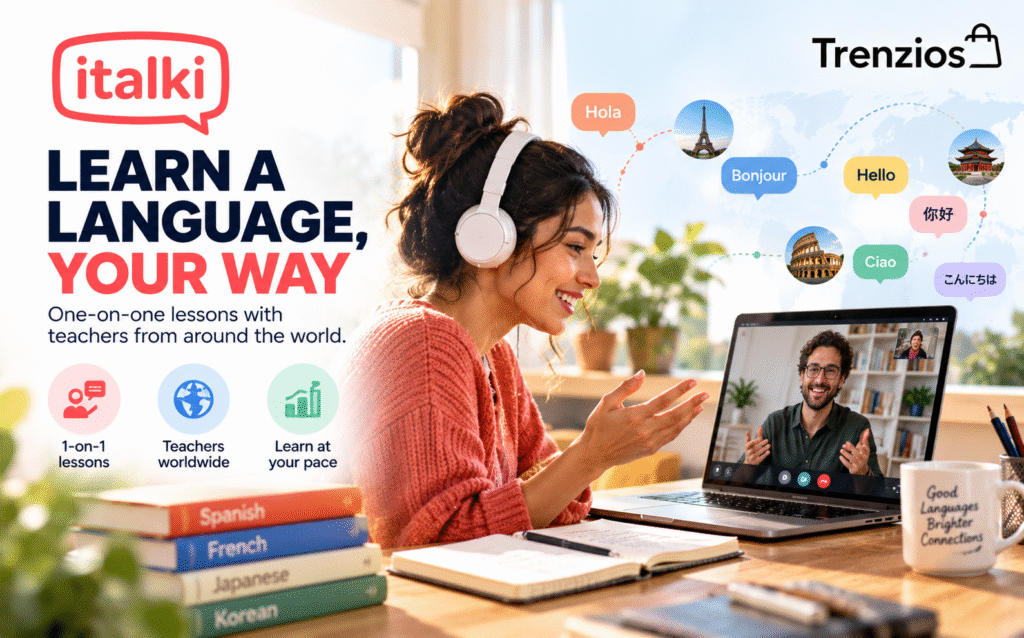
italki sits on that live-conversation side of the learning stack, connecting learners with individual language teachers and giving them the flexibility to book lessons around their goals and schedules. Its 2026 direction has also been reported as including further AI tools alongside improvements to its classroom experience and an emphasis on human connection.
That makes the platform relevant to a very current language-learning idea: don’t replace human practice with technology. Use technology to make human practice more productive.
READY TO SPEAK, NOT JUST STUDY?
FIND YOUR italki TEACHER →Explore italki language teachers and lessons
This article may contain affiliate links. If you purchase or book through a qualifying link, we may earn a commission at no additional cost to you.