
Most people leave money on the table at Alza. Not because the deals are hidden — they’re not, they’re all over the homepage — but because they don’t understand the shape of the promotional calendar, so they buy at the wrong moment and find out afterwards.
This is the version nobody writes: how the discounting actually works, what the different promotional mechanisms are for, and how to position yourself so you’re buying at the bottom rather than the middle.
There Are Several Different Things Going On, and They’re Not the Same
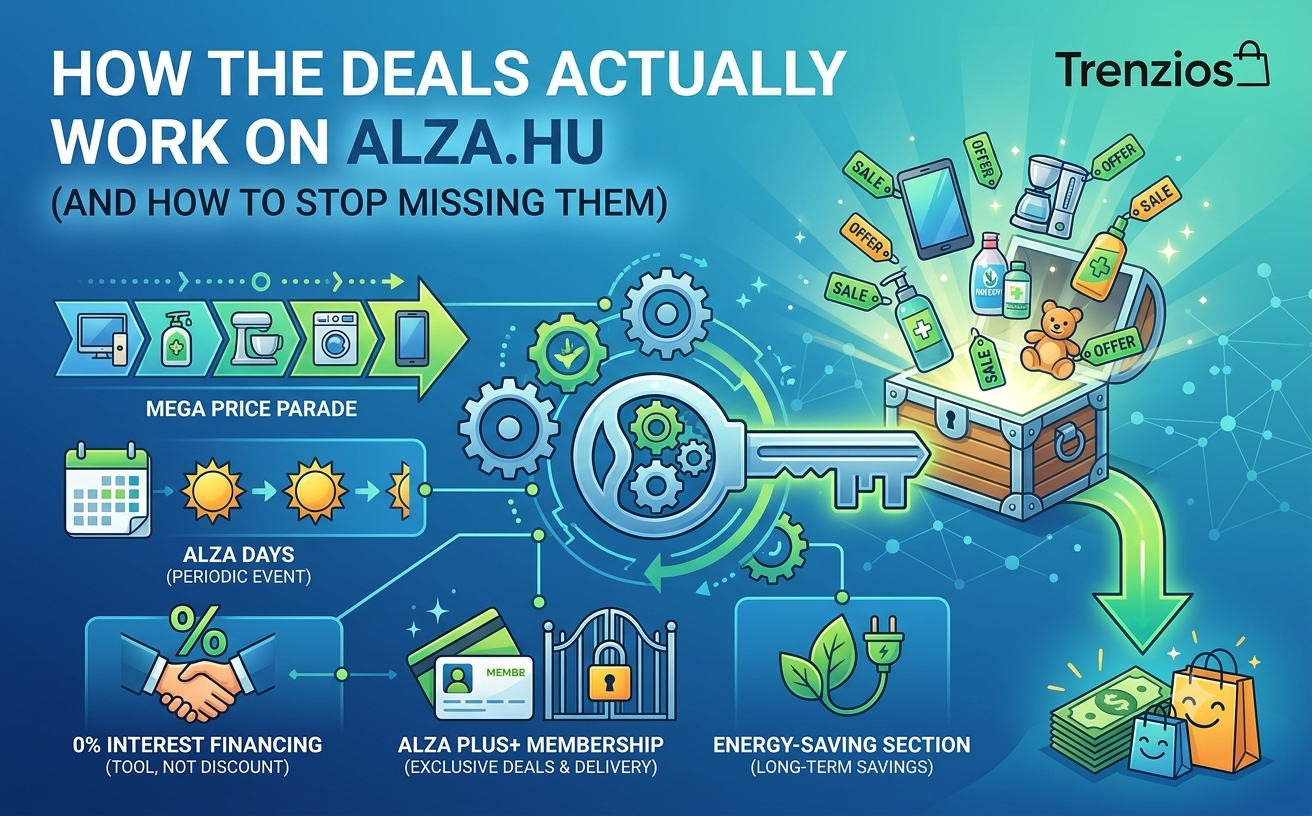
The single most useful thing to understand is that “a sale” on Alza isn’t one thing. There are at least four separate mechanisms running, often simultaneously, and they behave differently.
There’s the Mega Price Parade, which is the big cross-category event. It sweeps through everything — tech, appliances, drugstore, the lot — and it’s the closest thing to a general sale. It also spawns its own sub-events, so you’ll see brand-specific versions of it, and price-banded versions where everything under a certain threshold is discounted. Those sub-events are where the genuinely unexpected finds are, because they’re organised by price rather than category, which means you end up looking at things you’d never have searched for.
There’s Alza Days, which is the periodic flagship event and behaves more like a season than a weekend. Brands get their own moments inside it.
There’s the financing offers, which are a different animal entirely and which most people misread. Interest-free credit on televisions isn’t a discount. It’s better than a discount, on the right purchase, and I’ll come back to why.
And there’s the Alza Plus+ member deals section, which is a permanent, separate shelf of prices that only exist if you’re a member. That one’s the most consistently overlooked.
Understanding which mechanism applies to what you want is the whole game.
The Membership Is the Boring Answer That Actually Wins
Let’s deal with AlzaPlus+ properly, because it’s the least glamorous item here and probably the most valuable.
It’s a subscription. You pay monthly or annually. In exchange, delivery is free to the Alza Box lockers, to Alza stores, and to the Packeta, Foxpost and PostaPont pickup networks — which between them cover most of the country. There’s no minimum order value. There’s no cap on how often you order. You can cancel whenever you like, and if you haven’t used it, they refund it.
Here’s why that changes behaviour rather than just saving money.
Without free delivery, you don’t buy the one thing you need. You wait. You accumulate. You build a basket over three weeks until it’s worth the postage, and by then you’ve either bought the urgent item elsewhere at a worse price or forgotten what you needed. Delivery charges don’t just cost you the delivery charge — they distort every purchase decision you make.
With it, you order the cable when the cable breaks. You order the toothbrush heads when you run out. Each order is small and each order is free, and the annoying mental arithmetic disappears entirely.
Then there’s the second half, which people miss: members get exclusive prices on selected products, on their own shelf, redeemed through the app. Those aren’t the same prices everyone else sees. If you’re buying anything substantial, it’s worth checking that shelf before you check anything else.
And it works for business purchases too, which matters if you’re buying for a company as well as a household.
Financing Is Not a Discount, It’s a Different Tool
The interest-free financing that runs on televisions and other large purchases gets ignored by people who think of credit as something for people who can’t afford things. That’s the wrong frame.
Here’s the right one. When you buy a television, the regret curve runs one direction. Nobody has ever stood in front of a TV they bought and thought “I wish this were smaller and worse.” They think that about the one they didn’t buy. The same is true of the fridge, the washing machine, the laptop you’ll use for five years.
Interest-free credit doesn’t make the thing cheaper. It removes the reason you were about to buy the wrong one. If the cost of spreading the payment is nothing, then the only argument for buying down a tier was cashflow, and cashflow just stopped being an argument.
There’s also standard consumer credit with a choice of deposit and term for the purchases that don’t have an interest-free offer attached. Same logic, different maths — worth running the numbers rather than dismissing it.
The Energy-Saving Section Is a Deal Nobody Calls a Deal
This one’s subtle. There’s an energy-saving section in the catalogue that groups products by what they do to your running costs rather than by what they are.
That’s not a promotion. It’s a better one.
A discount saves you money once. An efficient appliance saves you money every month for as long as you own it, which on a fridge or a washing machine is a very long time. The cheapest appliance on the shelf is frequently the most expensive one you’ll ever own, and the gap doesn’t show up until the bills do.
So if you’re shopping appliances and you only look at the discounted shelf, you’re optimising the wrong number. Look at both. Sometimes the efficient one is also on offer, and that’s the actual win.
The Deals Reach Further Than You Think
One reason people miss value here is that they only look for promotions in the department they came for. But the events run across the whole catalogue, and the whole catalogue is much wider than most customers realise.
Phones, tablets, smartwatches, laptops, PC components, monitors, gaming, televisions, audio and cameras — that’s the half everyone knows. But the same events reach into large appliances, small appliances, smart home, kitchen goods, drugstore, perfume and jewellery, toys and baby, pet food and pet supplies, home and garden, sport and leisure, car and motorcycle, office supplies, health, and the food range with its sports nutrition and supplements.
Which means the discount you go looking for on a laptop is running simultaneously somewhere you weren’t looking. This is exactly what makes the price-banded sub-events valuable — when the sale is organised by what things cost rather than what they are, you’re browsing a shelf assembled by price across every department at once. That’s where people find the things they didn’t know they wanted, at prices that make the decision easy.
Brand-specific events work the same way from the other direction. If you’re loyal to a particular brand across audio or appliances, its moment comes round, and knowing that changes when you buy rather than whether.
Coupons, Vouchers and the Bits Around the Edges
There are discount coupons and voucher codes in circulation, redeemable in the basket. There are gift vouchers. There’s a referral mechanism where a code from a friend gets you a reduced membership. There are promotional AlzaPlus+ memberships that come attached to certain products, activating automatically.
None of these are enormous individually. Collectively, over a year of buying, they’re not nothing — and the effort required is roughly one glance at the basket page before you pay.
The single best habit here is trivial: check the promotions before you check the product. Open the deals section on the way in, not on the way out. It takes a minute and it occasionally reframes the whole purchase.
How to Actually Play This
Right. Practical version.
Before you buy anything substantial, check three places in order. The live event section, in case what you want is currently in a Parade or a Days promotion. The AlzaPlus+ deals shelf, in case there’s a member price. The financing options, in case interest-free credit is available on it. That’s a two-minute routine that runs before every meaningful purchase.
For the small stuff, don’t optimise at all. That’s what the membership is for. The whole point is that you stop thinking about it.
For appliances, cross-reference the deals against the energy-saving section rather than just taking the discount.
For anything you’re not in a hurry for, note that these events cycle. If you can wait, wait. Category-wide events come round, and the price-banded sub-events in particular are worth watching because they’re where the odd bargains surface.
And take the bestseller shelves seriously as a pricing signal. In an unfamiliar category, whatever’s outselling everything around it usually got there on price. That’s a shortcut, not a recommendation — but it’s a fast way to find the band where the value currently sits.
Why This Adds Up to Something
A discount on its own is easy. Every shop does discounts, and most of them are theatre.
What’s happening at Alza is more structural than that. There’s a membership that removes delivery friction permanently. There’s financing that removes the reason to buy the wrong thing. There’s a promotional calendar that actually rotates rather than running a permanent fake sale. There’s a section built around lowering your bills rather than lowering your basket. And there are member-only prices sitting on top of all of it.
Stack them and the difference across a year of household buying is real money — the kind you notice, not the kind you calculate.
Go and open the deals section. Then open the membership page. That’s the whole strategy, and it takes five minutes.