

The smarter way to train your basketball game in 2026
Two players can spend the same two hours in a gym and walk out with completely different results. One gets hundreds of random reps. The other works on a small number of skills, tracks what went wrong, and repeats the right actions until they become usable under pressure.
That difference is the real training problem. Basketball improvement is not simply about doing more. It is about knowing what to work on, how to progress it and whether the work is transferring to the game.
THE 4-QUESTION TRAINING AUDIT
Before your next workout, answer these four questions:
- WHAT breaks down most often in games — shooting, ball handling, finishing, footwork, defense or decisions?
- WHEN does it break down — under pressure, when tired, against a defender or at game speed?
- WHAT specific drill or progression trains that weakness?
- HOW will you know you improved?
That last question is the one players skip. A workout should have a scoreboard, even if it is not an actual game. Count makes, turnovers, successful moves, defensive stops, finishing percentages or completed repetitions. Without a measure, it is easy to confuse effort with progress.
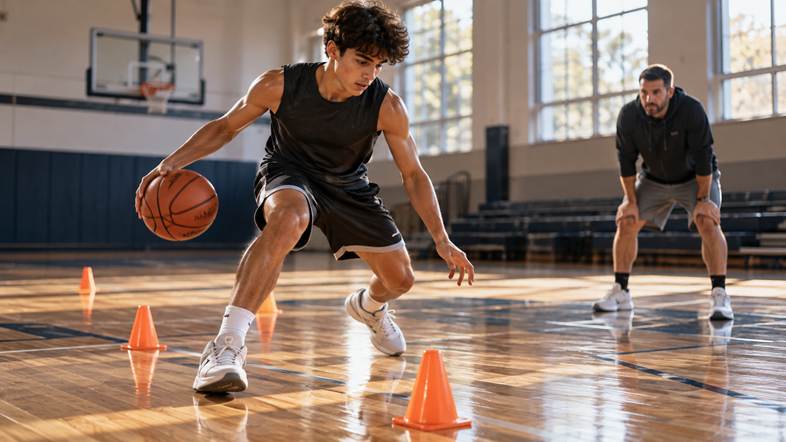
STOP TRAINING THE HIGHLIGHT. TRAIN THE MOMENT BEFORE IT.
A flashy move looks impressive in an empty gym. But games are usually decided by the details immediately before the highlight: the first step, change of pace, footwork, read, balance and decision.
Breakthrough Basketball emphasizes fundamentals and positive-impact coaching, and its training library covers shooting, ball handling, skill development, basketball workouts, defense, rebounding and offense.
BUILD A WORKOUT LIKE A GAME
A useful session can move through four stages:
- PREP — Warm up the movement and ball control you will need.
- SKILL — Work on the specific technique without unnecessary speed.
- DECISION — Add reads, constraints or defensive pressure.
- TRANSFER — Finish with game-like repetitions where the skill has to appear naturally.
If you are working on shooting, for example, do not spend the entire session standing in one spot. Progress from mechanics to movement, then to decisions: catch-and-shoot, relocation, attacking a closeout, pull-up or finishing depending on your role.
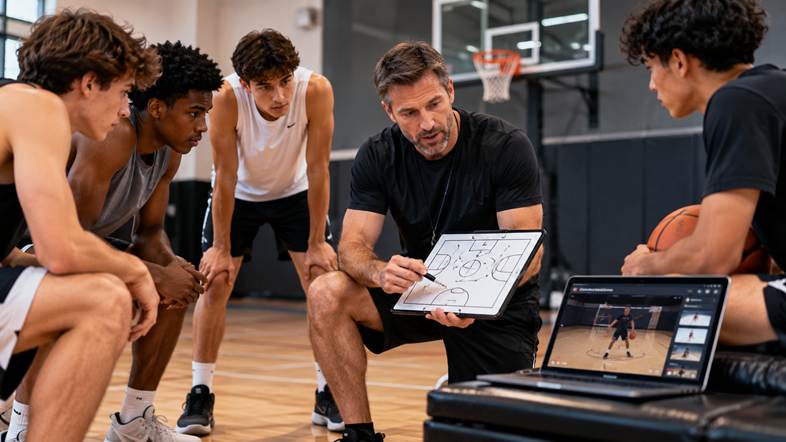
THE 30-MINUTE SMART WORKOUT
Short sessions can be useful when every minute has a purpose.
- 5 MINUTES — Ball control and movement warm-up.
- 10 MINUTES — One priority skill, with a clear target.
- 10 MINUTES — Game-action repetitions combining the skill with movement or a decision.
- 5 MINUTES — Pressure test: make a set number, beat a previous score or complete the sequence without a mistake.
The point is not that every player should train for exactly 30 minutes. The point is to remove empty reps. A shorter, focused workout can be easier to repeat consistently than an exhausting session with no clear objective.
IF YOU’RE A COACH, CHANGE THE QUESTION
Instead of asking, ‘Did we run enough drills today?’, ask, ‘Did the players learn something they can use tomorrow?’ Breakthrough Basketball offers resources ranging from youth coaching systems and practice plans to offensive concepts, defense, transition, skill development and all-access practices.
Structured resources are especially useful when a coach is trying to build a practice around a teaching objective rather than simply filling gym time.
THE PLAYER–PARENT CHECK-IN
Parents can help too, but the goal should not be turning every car ride home into a performance review. A better conversation is simple: What are you working on? What did you learn? What do you want to improve next?
Breakthrough Basketball currently offers more than 400 camps across the United States for different ages and skill levels. Its camps focus on basketball skills, confidence, mentality, basketball IQ and decision-making rather than simply running free-for-all scrimmages.
THE ‘RANDOM DRILLS’ TRAP
You do not need a new workout every day. Constant novelty can make training feel exciting while making progress difficult to measure.
- Pick one or two priorities.
- Repeat them long enough to see a change.
- Increase difficulty gradually.
- Add decisions and defensive pressure.
- Retest the original skill after the progression.

YOUR 7-DAY TRAINING RESET
Try this simple framework instead of chasing a different workout every day:
- DAY 1 — Identify your biggest game weakness.
- DAY 2 — Learn and repeat the fundamental movement.
- DAY 3 — Add movement and speed.
- DAY 4 — Add a decision or constraint.
- DAY 5 — Test the skill under fatigue or pressure.
- DAY 6 — Play and look for the skill in real possessions.
- DAY 7 — Review what actually transferred.
If a skill looks great in drills but never appears in games, the answer is not automatically ‘more drills.’ You may need better decision-making, more game-speed reps, or a simpler progression.
WHAT TO LOOK FOR IN A TRAINING PROGRAM
- Clear progressions rather than disconnected drills.
- Instruction that explains why the movement matters.
- Game-transfer opportunities.
- Different levels for different players.
- A structure a player or coach can actually follow.
- Enough repetition to build habits without turning practice into mindless volume.
THE BOTTOM LINE
Better basketball training is not about collecting the biggest library of drills. It is about finding the right problem, training it deliberately and testing whether it survives contact with the game.
Breakthrough Basketball combines camps, coaching resources, training videos, eBooks, workouts and other development tools for players, coaches and parents.
READY TO TRAIN WITH A PLAN? EXPLORE BREAKTHROUGH BASKETBALL →
Affiliate Disclosure
This article contains an affiliate link. If you purchase or sign up through the qualifying link, we may earn a commission at no additional cost to you.